Kimberley Primary School

Music
Music
At Kimberley primary School and Nursery, we believe that music is a universal language which inspires creativity, expression and connection. Through a high-quality music education, we aim to engage and inspire all pupils to develop a love of music, confidence in performance, and the skills to become thoughtful and reflective musicians. Our curriculum follows the National Curriculum for England and is delivered through the Charanga scheme, ensuring clear progression from EYFS through to the end of Key Stage 2.
In line with the National Curriculum, our music curriculum enables pupils to: perform, listen to, review and evaluate music across a range of periods, genres, styles and traditions learn to sing, use their voices confidently, compose and create music independently and collaboratively play tuned and untuned instruments with increasing skill and control understand how music is created, produced and communicated through the inter-related dimensions of music including pitch, tempo, dynamics, timbre, texture and notation
Music supports our whole-school values:
Gracious – celebrating the performances and ideas of others with kindness and respect
Resilient – developing perseverance through practice, rehearsal and performance
Empathy – understanding how music communicates feelings, experiences and cultures
Ambitious – striving for personal excellence and confidence in musical performance and composition
Thoughtful/Tolerant – appreciating music from diverse cultures, traditions and communities and valuing different viewpoints
Music also provides rich opportunities to develop Oracy through discussion, performance, explanation and evaluation. Pupils learn to articulate opinions, justify musical choices, perform with confidence and listen respectfully to others.
As a Rights Respecting School, we recognise every child’s right to express themselves, to participate fully in cultural and artistic life, and to have their voice heard. Music provides an inclusive platform where all children can contribute, collaborate and feel valued, supporting Article 12 (respect for children’s views), Article 13 (freedom of expression) and Article 31 (rest, play and participation in cultural life).
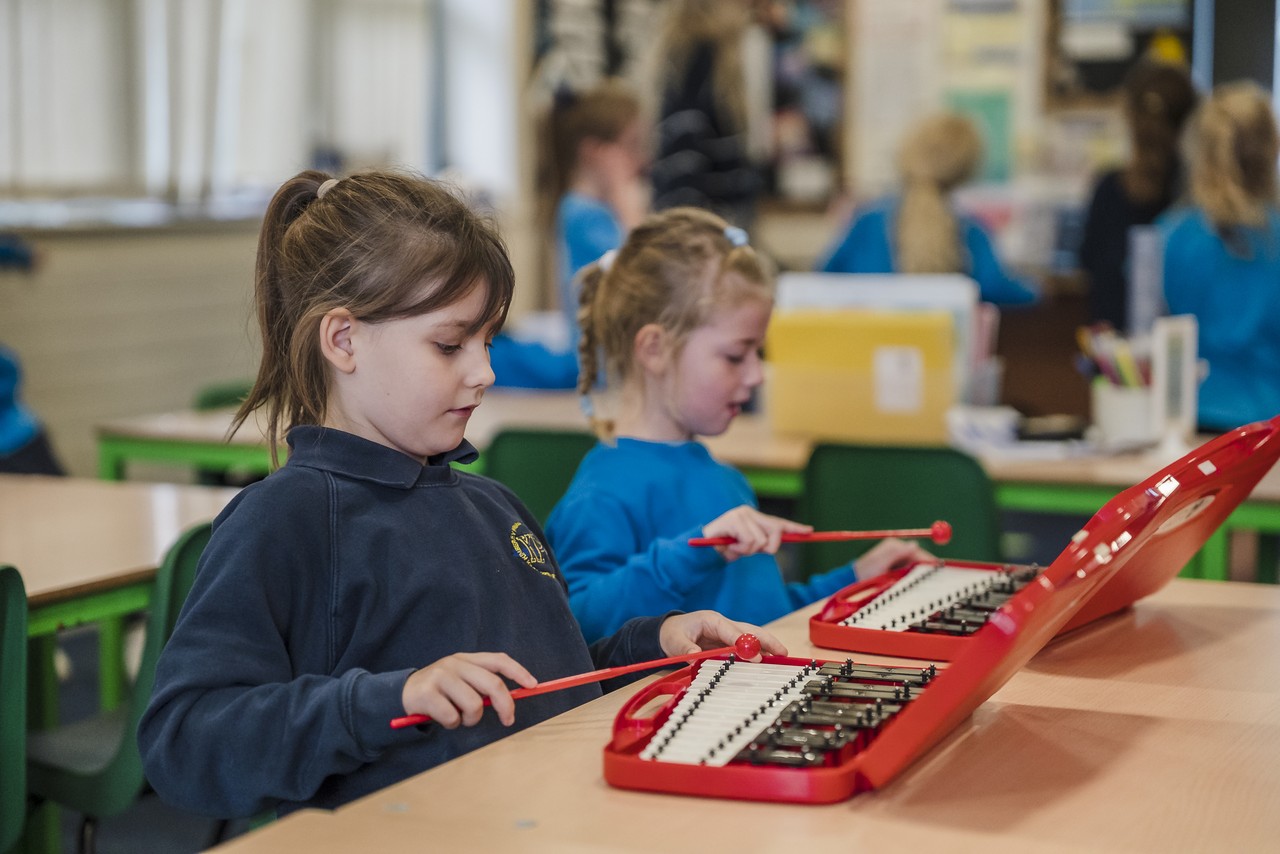
Music is taught weekly across EYFS, KS1 and KS2 using the progressive structure of the Charanga scheme. Lessons are carefully sequenced to build knowledge, vocabulary and practical skills over time, ensuring children revisit and deepen prior learning.
Our music curriculum is further enriched through performance opportunities, specialist teaching and wider musical participation across the school.
EYFS
In Early Years, music is taught through the Expressive Arts and Design area of learning. Children explore pulse, rhythm and rhyme through singing, movement, nursery rhymes, stories and play-based learning. They experiment with instruments, respond to different sounds and begin to express feelings through music.
Children develop:
- listening and attention skills confidence in singing familiar songs and rhymes
- turn-taking and collaborative performance
- expressive language and vocabulary through music-rich interactions
This early musical foundation strongly supports communication, language development and Oracy.
Key Stage 1
In KS1, pupils are taught to use their voices expressively and creatively, play tuned and untuned instruments, listen with concentration and begin composing simple pieces using the inter-related dimensions of music.
Through Charanga, pupils:
- sing songs and chants with increasing confidence
- explore pulse, rhythm and pitch perform simple patterns using percussion and classroom instruments
- listen and respond to a range of high-quality live and recorded music begin to discuss how music makes them feel and what they notice
Children are encouraged to perform positively, take risks and value the contributions of others.
Key Stage 2
In KS2, pupils build on prior knowledge by singing and playing with increasing confidence, control and expression. They develop understanding of composition, notation and musical structure and begin to perform both independently and collaboratively.
Through Charanga, pupils:
- perform in solo and ensemble contexts
- improvise and compose for a range of purposes
- use and understand staff notation and musical vocabulary
- listen with increasing attention to detail and recall sounds from memory
- study music from different traditions, composers and historical periods
- reflect on and evaluate their own and others’ performances
All children in Year 4 have the opportunity to learn a musical instrument through specialist whole-class tuition, providing valuable first-hand experience of instrumental performance and musicianship.
Extra-curricular instrumental lessons are also available for pupils in Key Stage 2 to access. We currently offer the opportunity to learn the following instruments:
- piano
- keyboard
- drums
- guitar
- ukulele